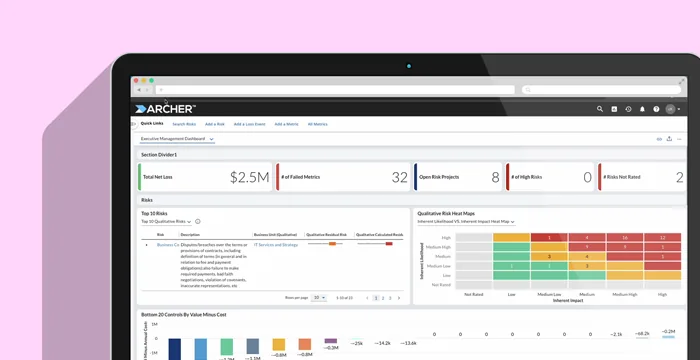
Enterprise UX · Research & Strategy

User & domain analysis — turning enterprise research into a product strategy

How deep stakeholder, expert, and customer research at RSA Archer produced five behavioural personas and a "Today vs. Tomorrow" vision that aligned the business on what to build — and why.

Senior Designer· RSA Archer (GRC)· Discovery → Synthesis → Insights· UX research · Personas · Service design
The short version

RSA Archer's GRC platform was powerful but hard to use. Before redesigning anything, our design team ran a structured discovery — 23 in-depth interviews across program owners, second-line-of-defence, and administrators at 15+ global enterprises, plus internal stakeholder and subject-matter-expert research — to find the "sweet spot" where business goals, program-owner goals, and user goals overlap. We synthesised the findings into five behavioural personas and Today / Tomorrow journey scenarios that gave the whole organisation a shared, evidence-based picture of what to build.

The work at a glance

23
in-depth interviews — program owners, 2LOD, and admins
3
research tracks: stakeholder, SME, and customer
5
behavioural personas grounded in real users
15+
global enterprises represented in the research

Context

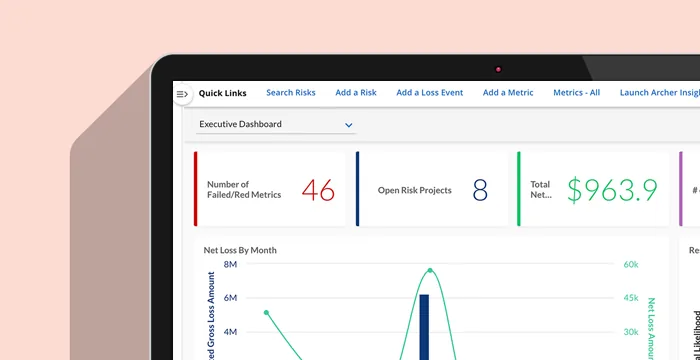
RSA Archer is a market-leading platform for governance, risk & compliance. The product was powerful, but complex and unintuitive — and a redesign was on the table. As a Senior Designer on a six-person design team, my role was to help ground that redesign in genuine understanding of the people who use it, rather than assumptions about them.

The risk was obvious: redesign the interface without first understanding the domain, and you simply rearrange the same confusion. So we started with research.

The challenge: finding the sweet spot

A redesign this size only succeeds where three sets of goals overlap. Our job in discovery was to map each one and find where they meet.

Business goals

What does RSA Archer need this redesign to achieve — for retention, growth, and the market?

Program-owner goals

What do the people who own risk programs need to prove value and scale?

User goals

What do the people doing the day-to-day work need to get it done without friction?

What we did

1

Discovery — three research tracks

We attacked the problem from three angles at once. Stakeholder research mapped the business goals, scope, timelines, opportunities and constraints — and surfaced where leadership agreed and where we needed to force clarity. SME research tapped the people inside RSA Archer who had lived this journey before, across product, engineering, support, education, professional services and sales engineering. Customer research went straight to the source: users' typical days, key processes, barriers, and desires.
2

Opportunity statements — clustered into three themes

The research produced dozens of verbatim pain points. Clustering them revealed a clear arc — users needed visibility into their data, insight from it, and the ability to take action:

Visibility
"We have the data, but can't find it."
"Getting data in and out is very difficult."
"I want to see the holistic view of risk."
Insight
"We need to make connections to understand the data."
"It's difficult to see trends."
"We don't know what the data means to be able to act."
Action
"We need to know what to do to reduce risk — and act quickly."
"We want to be proactive vs. reactive."
"I want to show we made a positive impact."
3

Synthesis — plotting behaviour to find patterns

Across the 23 interviews, we plotted every participant on behavioural spectrums — tactical ↔ strategic, reactive ↔ proactive, completes work ↔ oversees work, low ↔ high domain expertise, self-reliant ↔ reliant on others. Clusters emerged. Crucially, we grouped people by consistent goals and behaviours, not by job title or role — which is what made the resulting personas durable.

4

Five behavioural personas

The clusters became five provisional personas — named, evidence-based archetypes the whole team could design against.

GRC executive
The Innovator
"I want to drive change proactively through a holistic, data-driven, modern approach."

Proactive, strategic, high influence. Connects the dots to make data-driven decisions and inspires the enterprise to own risk at every level.

GRC program builder
The Progress-driven Strategist
"I want to focus on building the risk-management program by proving value."

Builds the program in a lower-maturity org. Needs evidence for regulators and stakeholders, and scalable processes that remove barriers to growth.

System administrator
The Enabler
"My job is to remove barriers to using the platform and make it easy to use."

The technologist who builds, maintains and evolves the platform — consulting business areas as the program onboards more groups.

Risk process owner
The Specialist
"I keep business users, process, and tools working together within a specific risk area."

Owns a specific risk area across the enterprise. Surfaces relevant information up the chain and enforces process to ensure timely compliance.

Individual contributor
The Task Driver
"I just need to get my tasks done. The system shouldn't slow me down — it should make it faster."

Reactive, focused, low oversight. Enters data accurately and on time — and will use workarounds the moment the tool gets in the way.

Method
Primary vs. secondary

We designed for the primary persona and accommodated the secondary — choosing between them on three axes: which covers the most functionality, who the business needs to attract or retain, and who represents the masses.

5

Context scenarios — a "Today vs. Tomorrow" vision

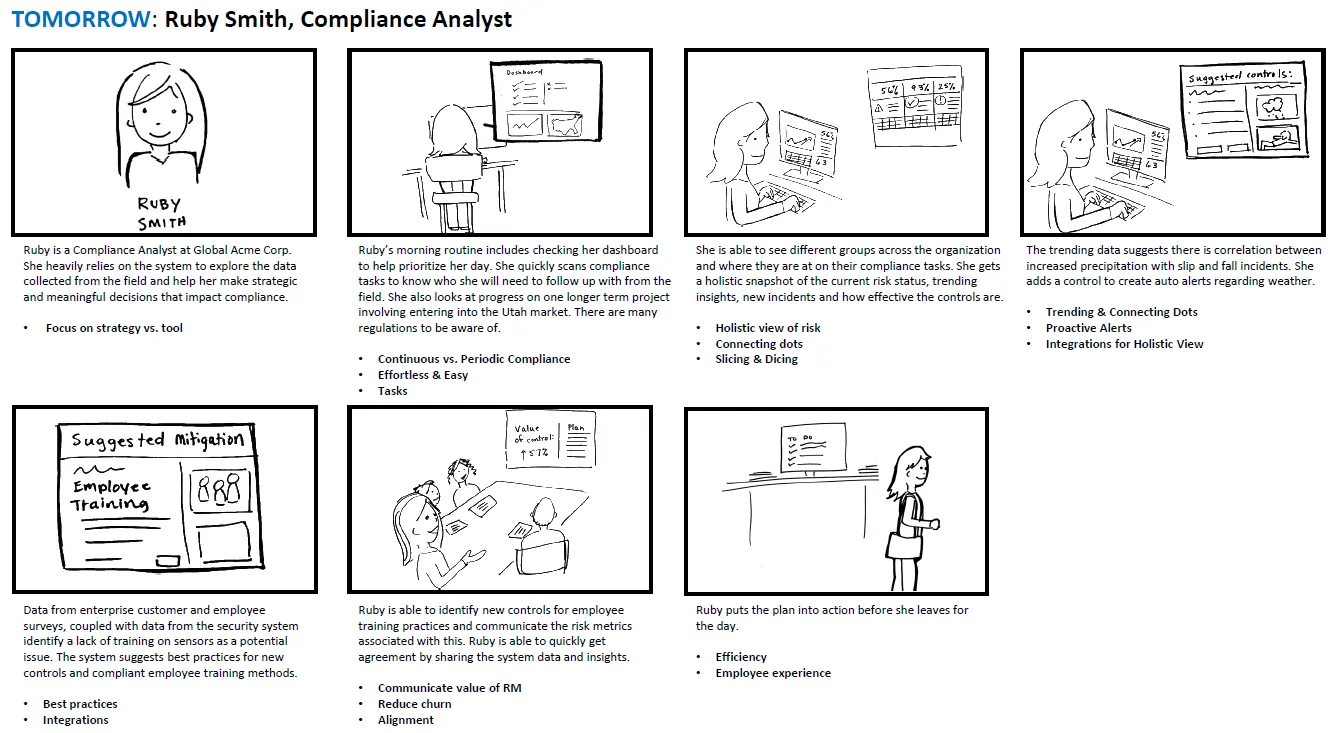
To make the personas tangible, we wrote day-in-the-life scenarios for primary personas — a store manager and a compliance analyst — contrasting their friction-filled present with the experience we were aiming for. This gave the whole organisation a shared, concrete picture of the future state.

Today — Ruby, Compliance Analyst

Stores struggle to use Archer, so Ruby manually re-enters data in whatever format she receives it. She feels like "a data-entry clerk with really bad tools" — doing necessary work that doesn't feel meaningful.

Tomorrow — Ruby, Compliance Strategist

Her dashboard prioritises her day and shows a holistic, trending view of risk. The system connects the dots — flagging a correlation between rainfall and slip-and-fall incidents — and she adds an automated control before lunch.

Storyboard of the Tomorrow scenario for the compliance analyst persona
A storyboard from the "Tomorrow" scenario — turning research into a narrative the whole team could rally around.

Insights — what the research told us to build

The findings distilled into six design principles for the next generation of the platform:

What I learned

Group people by goals, not roles. Job titles fragment; goals cluster. Building personas around consistent goals and behaviours is what made them stable enough to design against for years.

Research is an alignment tool, not just an input. The real output of discovery wasn't a document — it was a leadership team that finally agreed on the same problems and the same future state.

A "Today vs. Tomorrow" story moves an organisation. Personas tell you who; scenarios show everyone where you're going. Pairing them turned abstract research into a vision people could build toward.

Say hello

Feel free to reach out for collaborations — or just to meet up for a coffee.

me@abin.me